New Solid Dosage Granulating and Drying Line

New Solid Dosage Granulating and Drying Line

An integrated solid-dosage production route linking granulation, drying and material transfer.

Suitable for: solid-dosage production projects requiring coordinated granulation and drying equipment.
WhatsApp Now
WHAT ARE YOU LOOKING FOR?
*
This field is required
Total quantity you need
*
This field is required
*
This field is required
Email format error
Due to email instability, you might miss our correspondence. Please provide your phone number for alternative contact.
This field is required
Telephone information is wrong!
Send Message
  • Overview & Principle
  • Features & Materials
  • Applications
  • FAQ
Product Overview
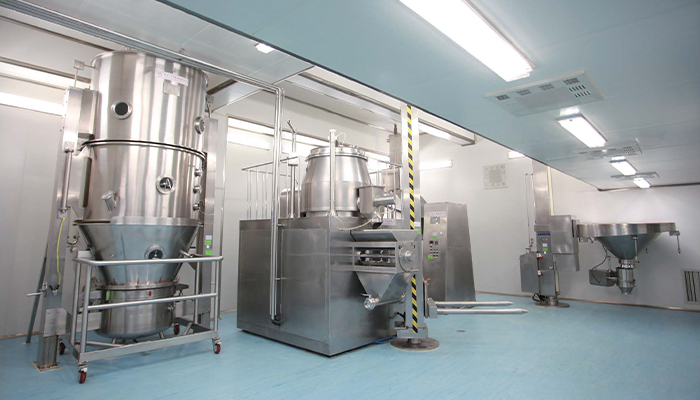
The New Solid Dosage Granulating and Drying Line integrates wet mixing and granulation, wet sizing, fluid-bed drying, dry sizing, material transfer and final blending for solid-dosage production. The coordinated arrangement reduces intermediate handling between process stages.
Working Principle

Material is transferred through the configured sequence of wet mixing and granulation, wet sizing, fluid-bed drying, dry sizing, screening and final blending. Connected conveying and lifting equipment moves the material between stages in accordance with the selected production-line arrangement.
2.jpg


3.jpg

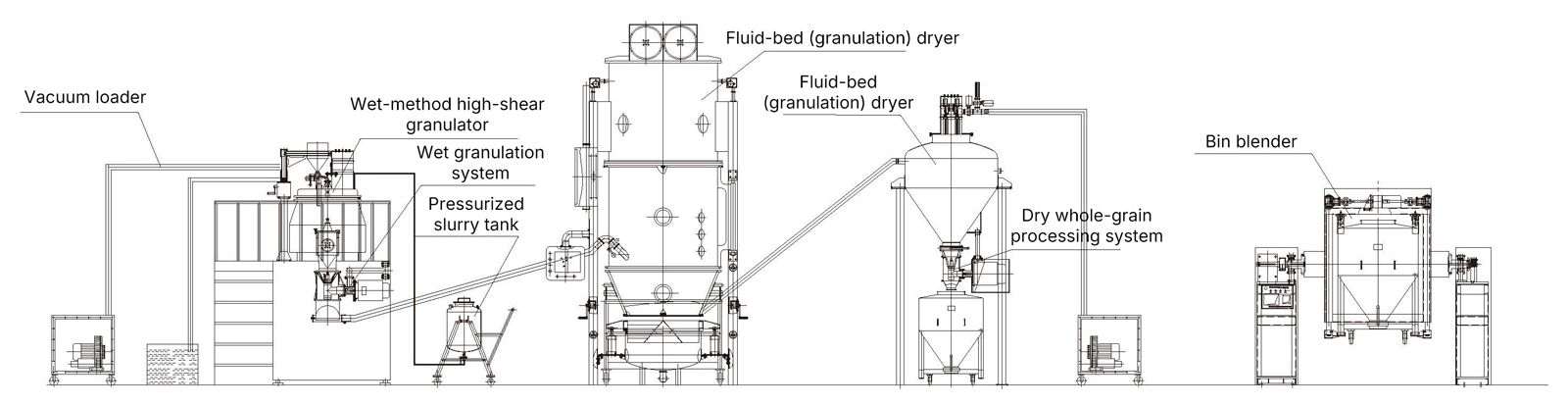
After the materials are weighed, they are negatively drawn by a vacuum feeder into a wet granulator. The binder liquid is atomized through a pressure feeding tank and spray nozzle into the wet granulator, where it mixes with the fine powder to form a soft mass. At the same time, the granulating knife cuts the soft mass into wet granules. The wet granules are then uniformly sized by a wet sizing machine. Under the negative pressure of a fluid bed dryer, the sized wet granules are suctioned into the fluid bed dryer for drying. The dried materials are discharged via a vacuum discharger, subjected to dry sizing, and then transferred into a bin blender for final mixing, after which they proceed to the subsequent processes.


4.jpg

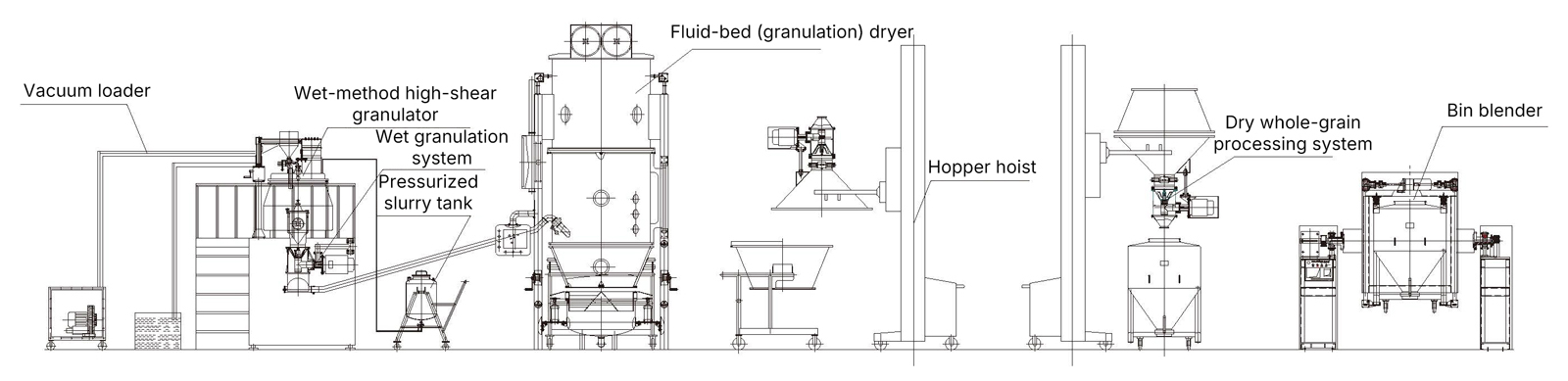
After the materials are weighed, they are negatively drawn by a vacuum feeder into a wet granulator. The binder liquid is atomized through a pressure feeding tank and spray nozzle into the wet granulator, where it mixes with the fine powder to form a soft mass. At the same time, the granulating knife cuts the soft mass into wet granules. The wet granules are then uniformly sized by a wet sizing machine. Under the negative pressure of a fluid bed dryer, the sized wet granules are suctioned into the fluid bed dryer for drying. The dried materials are discharged via a hoist elevator, subjected to dry sizing, and then transferred into a bin blender for final mixing, after which they proceed to the subsequent processes.


5.jpg

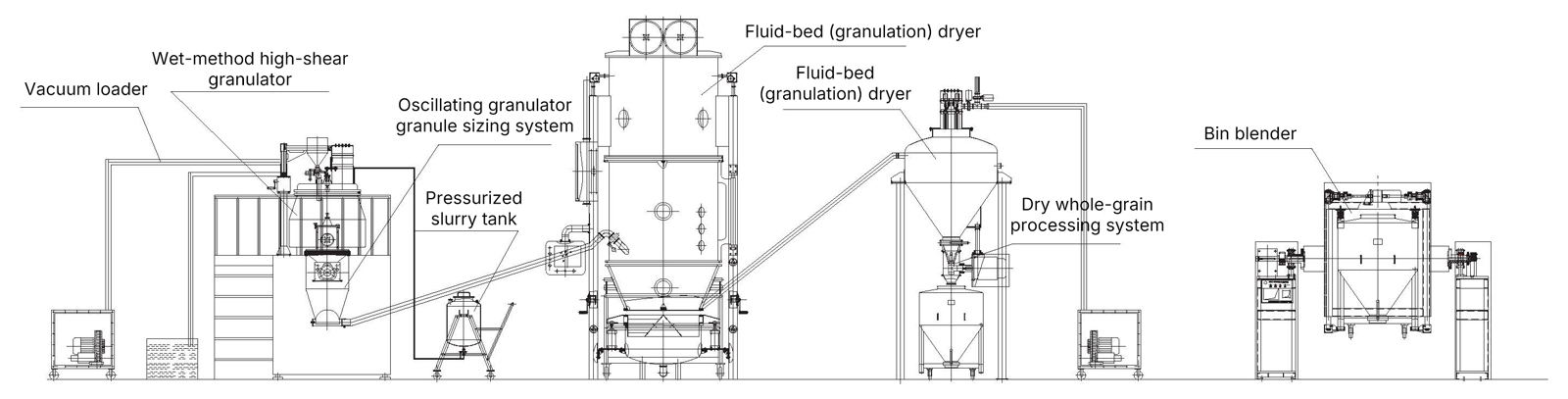
After the more viscous materials are weighed, they are negatively drawn by a vacuum feeder into a wet granulator. The binder liquid is atomized through a pressure feeding tank and spray nozzle into the wet granulator, where it mixes with the fine powder to form a soft mass. At the same time, the granulating knife cuts the soft mass into wet granules. The wet granules are then uniformly sized by an oscillating granulator. Under the negative pressure of a fluid bed dryer, the sized wet granules are suctioned into the fluid bed dryer for drying. The dried materials are discharged via a vacuum discharger, subjected to dry sizing, and then transferred into a bin blender for final mixing, after which they proceed to the subsequent processes.



Key Features
Designed for an integrated solid-dosage production route linking granulation, drying and material transfer.
The equipment and control configuration are selected according to the material and process requirements.

6.jpg

Suitable Materials
Solid-dosage production projects requiring coordinated granulation and drying equipment.
Material suitability should be confirmed through review of physical properties, moisture or solvent content, temperature sensitivity and the required final product condition.


Wide Range of Applications
Applications include solid-dosage production projects requiring coordinated granulation and drying equipment. Final suitability should be confirmed from the material characteristics and process requirements.


Frequently Asked Questions
What is the primary function of the New Solid Dosage Granulating and Drying Line?
Its primary function is an integrated solid-dosage production route linking granulation, drying and material transfer.
What materials can be processed?
Solid-dosage production projects requiring coordinated granulation and drying equipment. Final suitability should be confirmed through material and process evaluation.
How should a model be selected?
Confirm the material route, batch or line capacity, upstream and downstream interfaces, containment requirement, cleaning method and control scope against the selected equipment configuration.

Request Pricing & Specifications

Interested in this equipment? Fill out the form below with your required capacity and material details. Our team will send you a competitive quote and a comprehensive technical data sheet within 24 hours.
Talk to Our Drying Experts
With over 30 years of manufacturing expertise and continuous R&D, YIBU delivers reliable technical support and equipment recommendations for your specific processing needs.
Company Name
*
This field is required
Email
*
This field is required
Email format error
Phone
This field is required
Telephone information is wrong!
Message
*
This field is required
Send Message