

How Airflow Drying Combines Pneumatic Conveying and Moisture Removal
Airflow Dryer Series

Rapid drying with simultaneous dispersion in a rotating hot-air field.
Suitable for: pastes, filter cakes and wet solids that can be dispersed for flash drying.

Pneumatic drying configured for starch processing.
Suitable for: starch materials within the operating range.

Rapid pneumatic conveying and drying in a hot gas stream.
Suitable for: dispersible wet powders and particulate materials suitable for air-stream drying.

Direct-contact pneumatic drying in a conveying air stream.
Suitable for: dispersible moisture-bearing solids suitable for short-residence drying.

Two-stage pneumatic drying using positive- and negative-pressure sections.
Suitable for: materials requiring the two-stage air-stream process.
Integrated Production Line
A complete airflow drying line may include air filtration and heating, feed metering or dispersion, the selected dryer body and conveying duct, cyclone and bag collection, exhaust treatment, pneumatic conveying, sifting, and packaging. Upstream dewatering or size reduction can be integrated when required by the feed. The final system boundary is defined by the material, selected series, and agreed project scope.
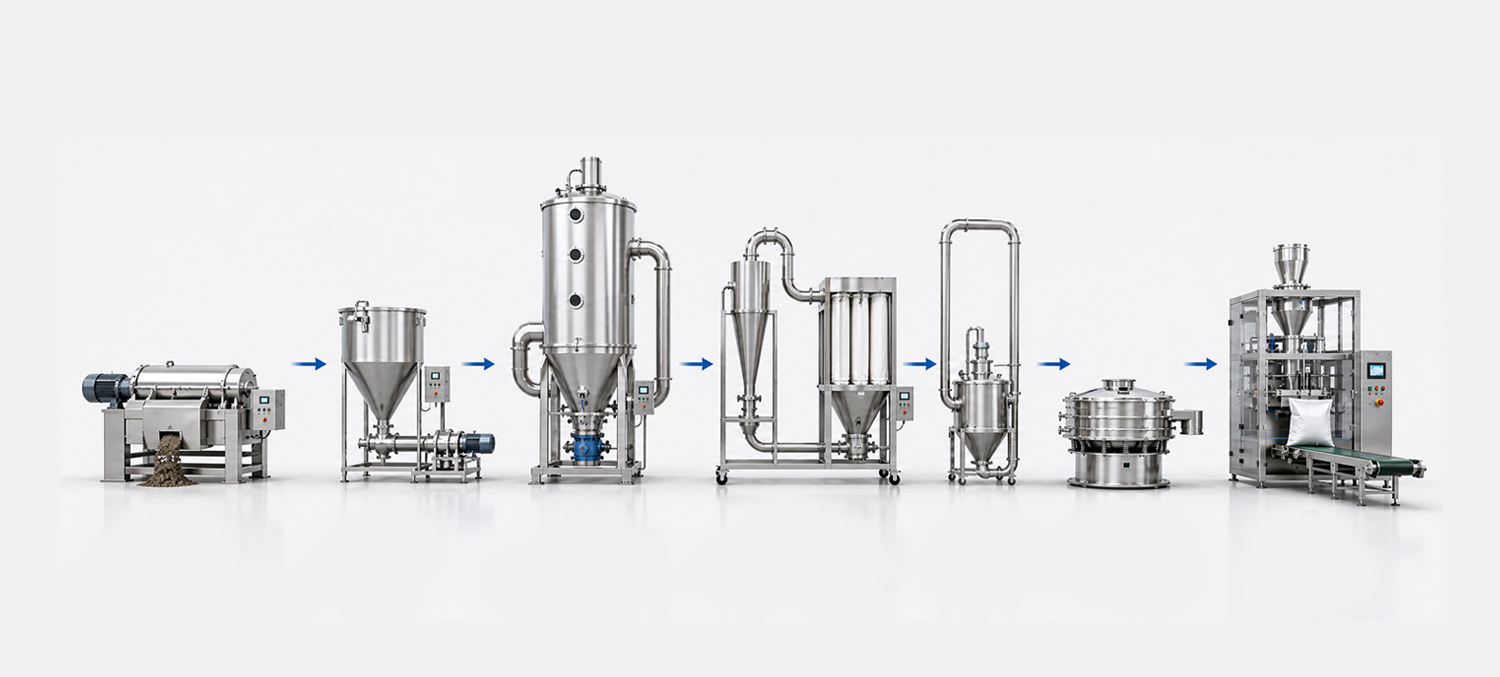
Dewatering
Airflow Drying
Conveying
Packaging
Feeding
Product Collection
Screening
Pilot Testing & Project Support
YIBU's 2,000m² Pilot Laboratory can evaluate feed dispersion, pneumatic conveying behavior, drying response, residence requirements, final moisture, particle condition, powder recovery, and scale-up data. Please provide the material name and composition, feed form, initial moisture, particle size, bulk density, thermal sensitivity, solvent or dust-safety information, target capacity, and required final product condition.
Airflow Dryer Technical FAQ
- Q: Is a spin flash dryer the same as an airflow dryer?A: Spin flash drying is one specialized airflow-drying method. XSG equipment uses a rotating hot-air field and mechanical dispersion for suitable pastes, filter cakes, and wet solids, while DG, JG, QG, and FG use other pneumatic drying arrangements for different feed and process requirements.
- Q: How should an airflow dryer series be selected?A: Selection should be based on feed form, moisture content, dispersion behavior, required evaporation duty, thermal sensitivity, target final moisture, particle requirements, collection method, available utilities, and site constraints. Material testing is recommended when the conveying or drying behavior is uncertain.
- Q: Can filter cakes or pastes be processed by airflow drying?A: Suitable filter cakes and pastes may be evaluated for the XSG spin flash route because it combines mechanical dispersion with rapid drying. Direct processing depends on the material's structure, stickiness, moisture, feeding stability, and required product condition.
- Q: How are final moisture and product condition controlled?A: They are influenced by feed rate, air temperature and volume, dispersion, gas velocity, drying-path or stage arrangement, residence behavior, and product separation. The relevant variables are confirmed together for the selected series and material.
Find the Right Airflow Dryer for Your Process