

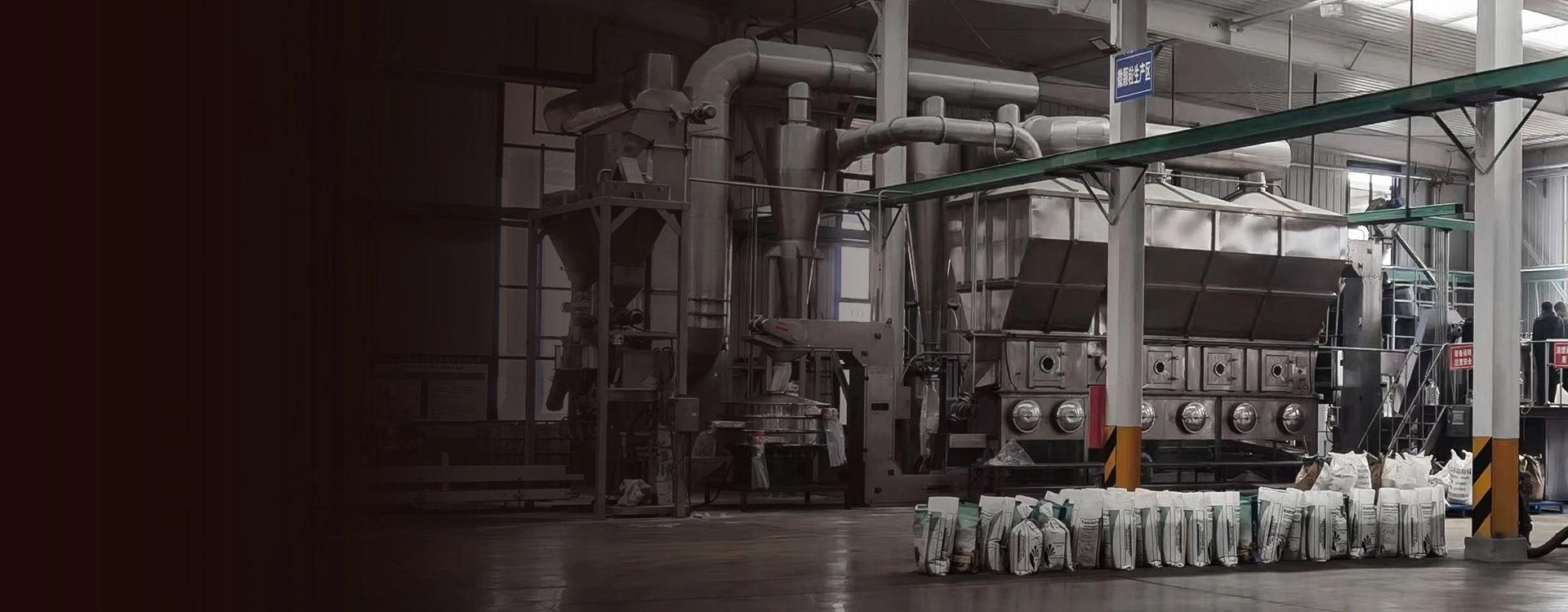
Controlled Fluidization for Uniform Drying and Cooling
Fluid Bed Dryer Series

Vertical fluid-bed drying of wet powder or granular material.
Suitable for: free-flowing wet powders and granules suitable for fluidization.

Fluid-bed granulation and drying in a closed-circuit gas system.
Suitable for: materials requiring a closed-circuit processing arrangement, subject to solvent and safety evaluation.

Continuous horizontal fluid-bed drying.
Suitable for: granular or particulate materials suitable for continuous fluidization.

Closed-circuit fluid-bed drying or cooling.
Suitable for: materials requiring controlled recirculating-gas drying or cooling.

Fluid-bed drying supplemented by internal heat-transfer surfaces.
Suitable for: fluidizable materials requiring increased heat-transfer area.
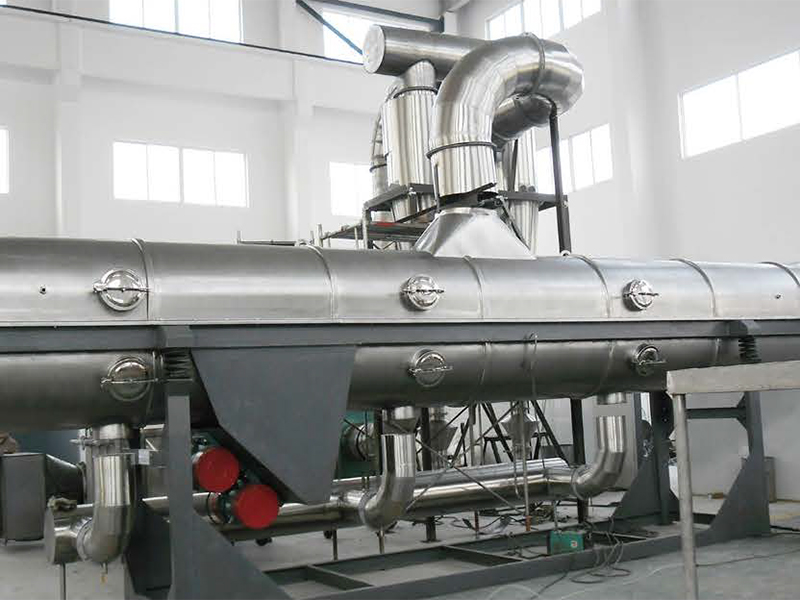
Vibration-assisted fluid-bed drying and cooling.
Suitable for: granular, crystalline or particulate materials that can be conveyed across a vibrating fluidized bed.
Integrated Production Line
Fluid bed dryers can be integrated with wet granulation or dry compaction, lifting and charging, milling, sifting, blending, conveying, and packaging. For solid-dose production, a typical line may connect a GHL high-shear granulator, FG vertical fluid bed dryer, KZL cone mill, sifter, and HLD bin blender.
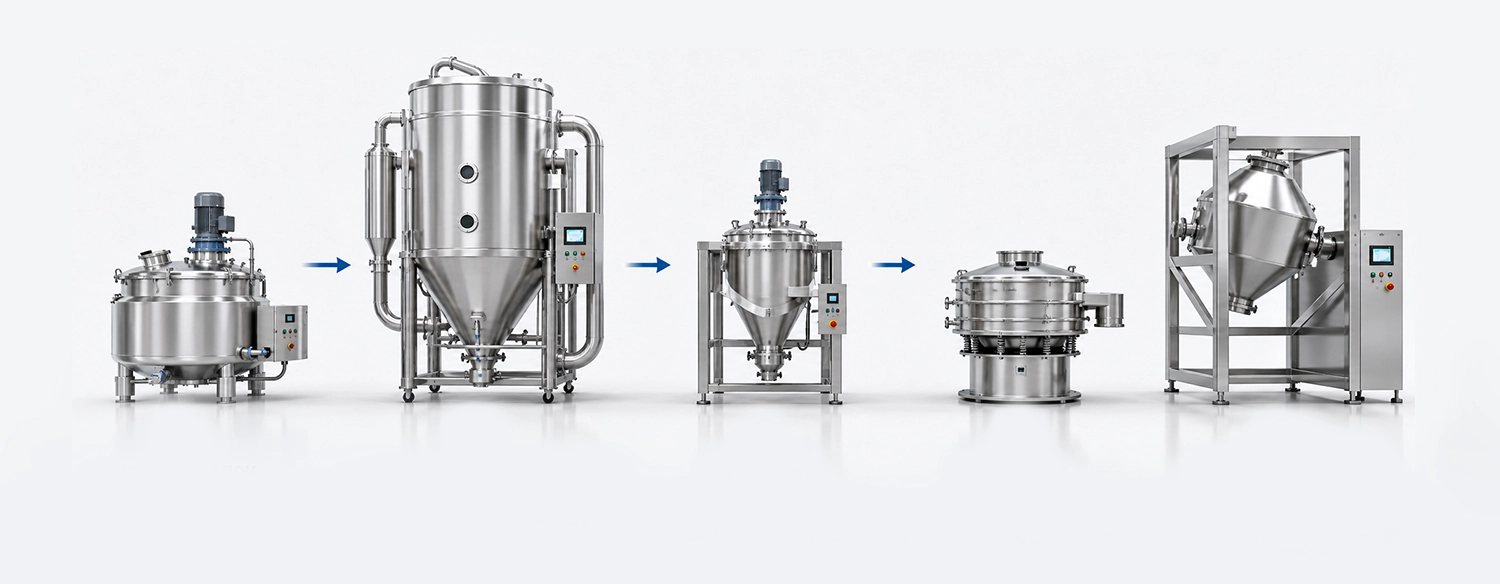
GHL Granulation
FG Fluid Bed Drying
KZL Sizing
Screening
HLD Final Blending
Pilot Testing & Project Support
YIBU's 2,000m² Pilot Laboratory supports fluidization observation, drying-curve development, final-moisture evaluation, particle-integrity checks, and scale-up data collection. For initial selection, please provide the material name, particle-size distribution, bulk density, initial and target moisture, heat sensitivity, required capacity, and available utilities.
Fluid Bed Dryer Technical FAQ
- Q: What is the difference between a vibrating and a non-vibrating fluid bed?A: A vibrating fluid bed adds mechanical movement to assist conveying and fluidization. It is often considered for crystals, irregular granules, or products that benefit from lower air velocity. A non-vibrating bed may be more suitable for readily fluidizable powders or batch processing.
- Q: Should I choose a batch or continuous fluid bed dryer?A: Batch systems are often selected for traceable recipes, frequent product changes, and contained pharmaceutical processing. Continuous systems are typically considered for stable, high-volume production. The final choice depends on product behavior, capacity, cleaning, and production planning.
- Q: Can organic-solvent materials be processed?A: Potentially, using a project-specific closed-loop system. A complete process and safety review is required before configuration, including solvent properties, oxygen limits, dust explosibility, recovery targets, and applicable standards.
Need Help Choosing the Right Fluid Bed Dryer?