

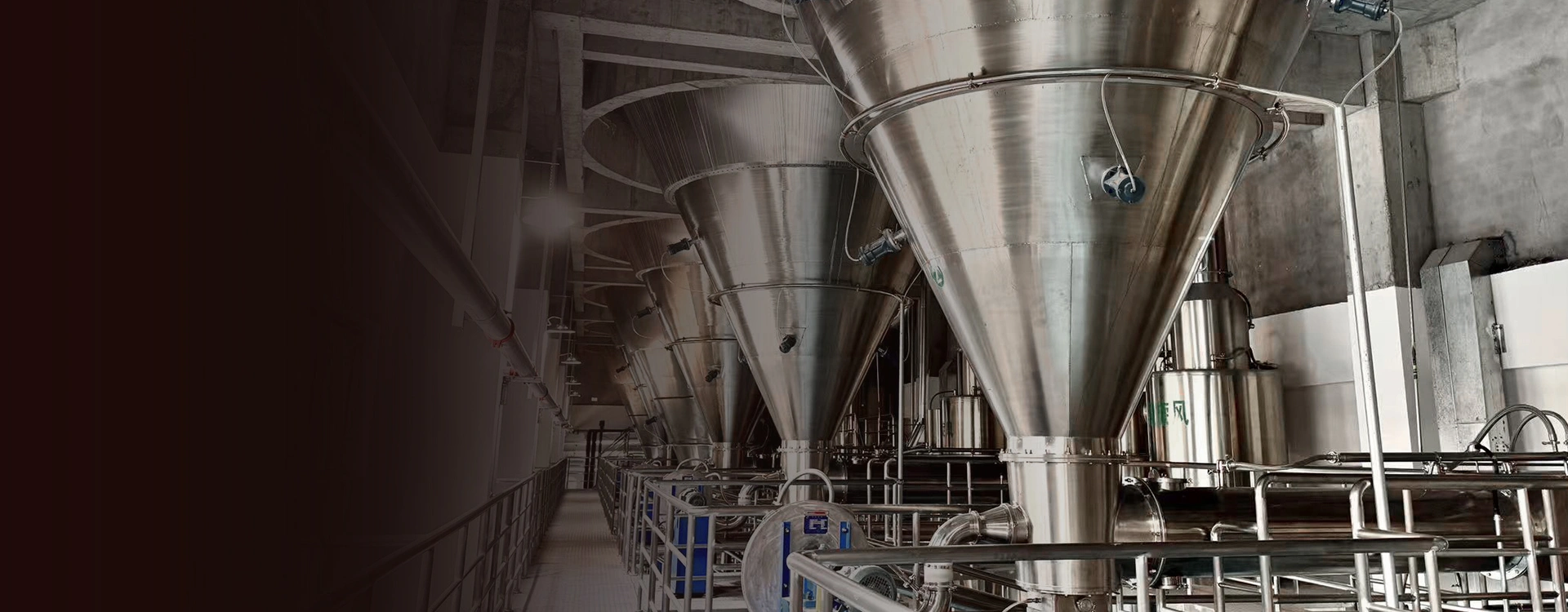
How Spray Drying Converts Liquid Feed into Powder
The final powder properties depend on the feed composition, solids content, viscosity, atomization method, inlet and outlet temperatures, air-flow pattern, residence time, and recovery configuration. YIBU evaluates these variables together to select the dryer type and operating window for each material.
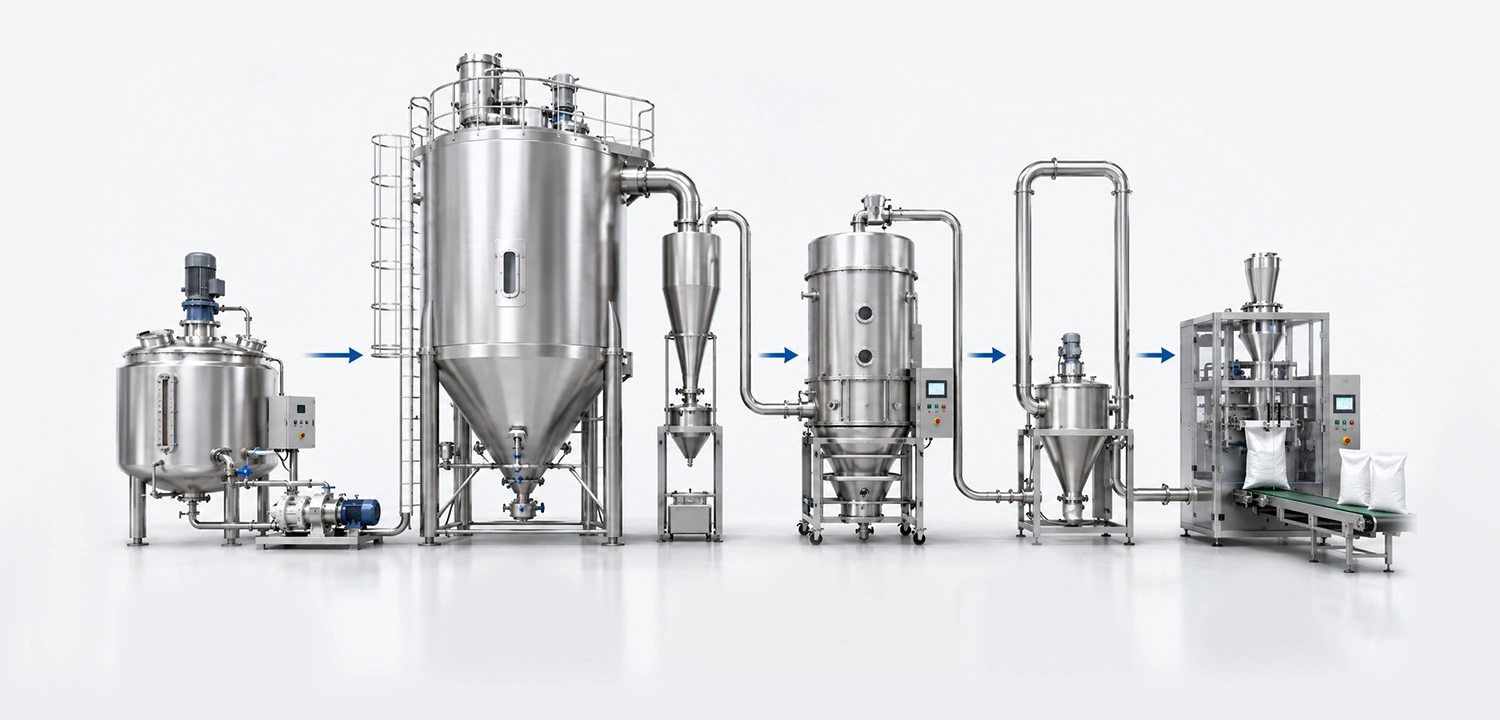
 Feed Preparation & Delivery
The feed is mixed or homogenized and delivered to the atomization system at a controlled rate.
 Atomization
A pressure nozzle or centrifugal atomizer converts the feed into fine droplets.
 Drying
The droplets contact heated air, allowing rapid moisture evaporation under controlled temperature conditions.
 Powder Recovery
Dried particles are collected through the main chamber, cyclone, bag filter, or other suitable recovery equipment.
Spray Dryer Series

The YPG Series uses a pressure nozzle at the top of the tower to atomize the feed into a co-current hot-air stream. Feed pressure, nozzle selection, feed rate, and drying conditions are coordinated to develop the required powder or granule characteristics.

Centrifugal atomization of liquid feed followed by rapid hot-air drying.

Centrifugal spray drying configured for traditional Chinese medicine extracts.

Pressure atomization in a mixed-flow drying arrangement.

Pressure-nozzle spray drying in a horizontal chamber arrangement.

Pressure-nozzle spray drying with a top-air-outlet arrangement.

Centrifugal spray drying in a closed-loop gas circuit.

Pneumatic atomization followed by spray drying.

Spray drying in an aseptic-oriented system configuration.
Integrated Production Line
Spray Drying Technical FAQ
- Q: How do I choose between pressure and centrifugal atomization?A: The choice depends on feed properties, target particle size and shape, bulk density, solubility, capacity, and cleaning requirements. Pilot testing is recommended when the product specification is sensitive to atomization conditions.
- Q: How can wall deposition be reduced when drying herbal or high-sugar extracts?A: The solution may combine feed conditioning, controlled inlet and outlet temperatures, wall cooling, air sweeping, dehumidified conveying air, and an appropriate collection route. The exact combination should be determined from the feed characteristics and test results.
- Q: Can YIBU support pharmaceutical qualification documentation?A: Yes. Depending on the agreed project scope, YIBU can review the customer's URS, prepare design and qualification documents such as DQ, IQ, and OQ, execute FAT and SAT documentation, and support customer-led PQ activities.