QJ Series Hollow Paddle Dryer

QJ Series Hollow Paddle Dryer

Indirect heating through hollow paddles with continuous agitation.

Suitable for: pastes, cakes, powders and granules suitable for paddle drying.
Model:QJ
WhatsApp Now
WHAT ARE YOU LOOKING FOR?
*
This field is required
Total quantity you need
*
This field is required
*
This field is required
Email format error
Due to email instability, you might miss our correspondence. Please provide your phone number for alternative contact.
This field is required
Telephone information is wrong!
Send Message
  • Overview & Principle
  • Features & Materials
  • Applications
  • Technical Parameters
  • FAQ
Product Overview
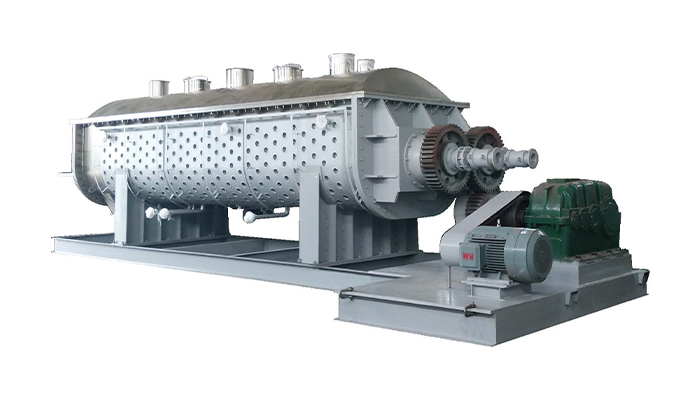
The QJ Series Hollow Paddle Dryer provides indirect heating through hollow paddles with continuous agitation. Typical materials and duties include pastes, cakes, powders and granules suitable for paddle drying.
Working Principle

Heat-transfer medium flows through the jacket, hollow shafts and hollow paddles. The rotating paddles mix and convey the material, continually renew its contact with the heated surfaces, and release vapor through the exhaust connection.

1.jpg


QJ.jpg


Key Features
Designed for indirect heating through hollow paddles with continuous agitation.
The equipment and control configuration are selected according to the material and process requirements.

2.jpg

Suitable Materials
Pastes, cakes, powders and granules suitable for paddle drying.
Material suitability should be confirmed through review of physical properties, moisture or solvent content, temperature sensitivity and the required final product condition.


Wide Range of Applications
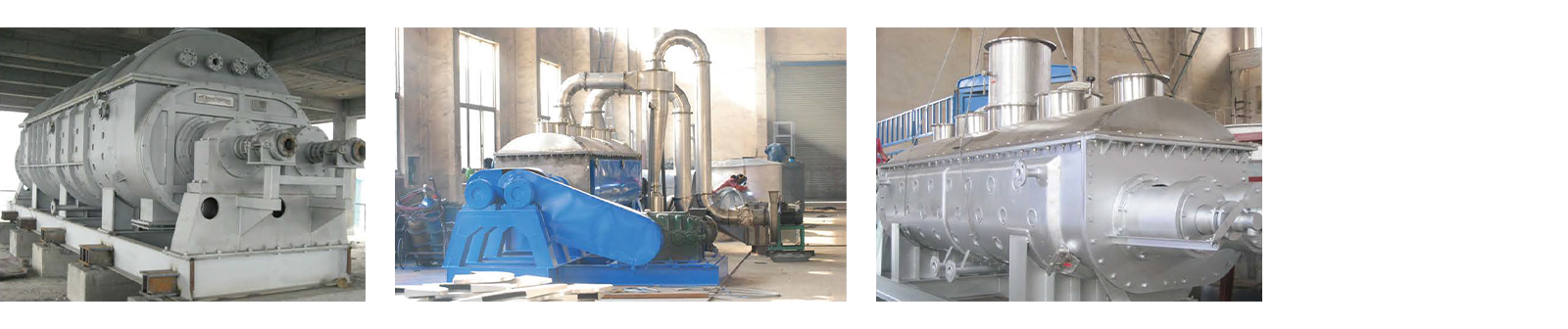
Paddle dryers have been successfully used in fields such as food, chemicals, petrochemicals, dyes, and industrial sludge. The equipment's characteristics of heat transfer, cooling, and mixing enable it to perform the following unit operations: combustion (low-temperature), cooling, drying (solvent recovery), heating (melting), reaction, and sterilization. The stirring paddles also serve as heat transfer surfaces, increasing the heat transfer area per unit of effective volume and shortening processing time. The wedge-shaped paddle heat transfer surface also has a self-cleaning function. The compression-expansion stirring function ensures uniform mixing of materials. The material moves axially in a "plug flow" pattern, and within the axial zone, the temperature, humidity, and mixing degree gradients of the material are very small. Using heat transfer oil as the heating medium, the paddle dryer can perform low-temperature combustion work. For example: calcium sulfate dihydrate (Ca₂SO₄·2H₂O) is converted to calcium sulfate hemihydrate (Ca₂SO₄·1/2H₂O) through combustion. Sodium bicarbonate (NaHCO₃) is converted to soda ash (Na₂CO₃) through combustion, etc. By introducing a cooling medium such as water or cooled brine, it can be used for cooling. For example: the paddle-type soda ash cooler used in the soda ash industry replaces the old air-cooled soda ash cooler, saving energy and tail gas treatment equipment, and reducing operating costs. Drying, the most important function of the equipment, does not use hot air, making solvent recovery, energy consumption, and environmental control in an ideal state that is easy to handle. It is particularly suitable for materials requiring solvent recovery, flammable, easily oxidized, and heat-sensitive materials. It has been widely used in fine chemicals, petrochemicals, and dye industries. Within the axial zone, the uniformity of temperature, humidity, and mixing degree allows the equipment to be used for heating or melting, or for conducting some solid material reactions. It has been successfully used in the compound fertilizer and modified powder industries. The paddle dryer can be used for sterilization treatment of food and flour. The large heating area per unit of effective volume quickly heats the material to the sterilization temperature, avoiding prolonged heating that would alter the material quality.


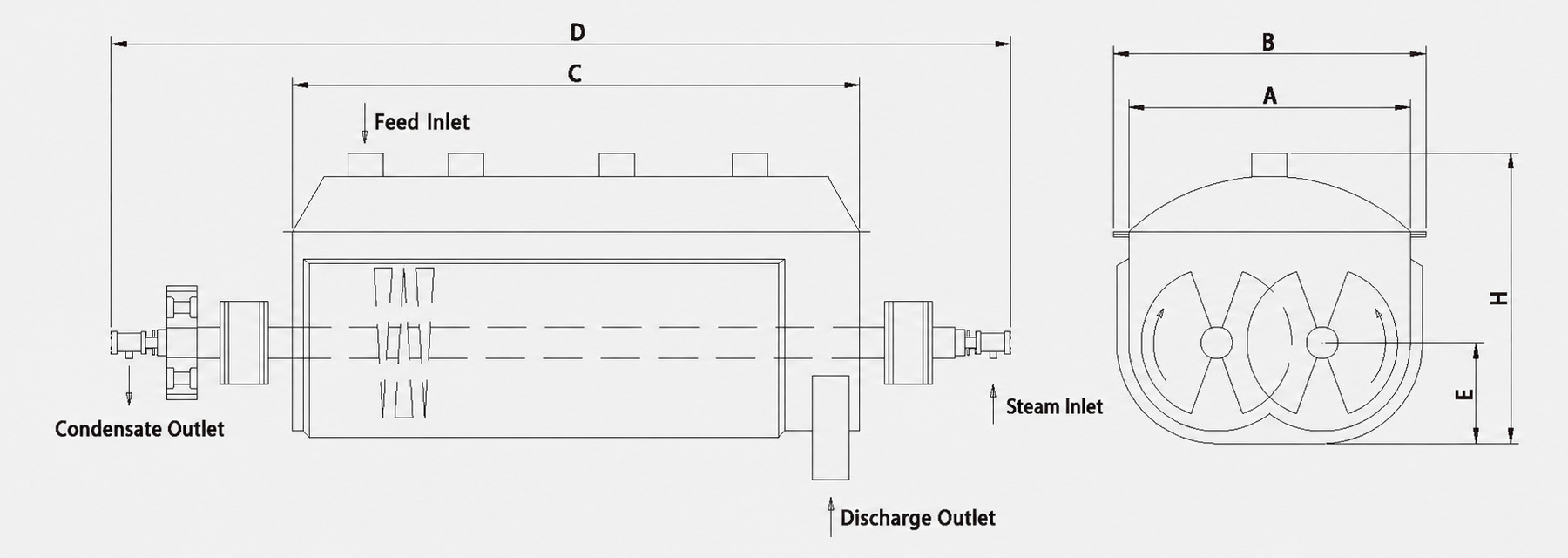
Technical Parameters

ModelQJ3QJ9QJ13QJ18QJ29QJ41QJ52QJ68QJ81QJ95QJ110QJ125QJ140
Heat-Transfer Area (m²)391318294152688195110125140
Effective Volume (m³)0.060.320.591.091.852.83.965.216.438.089.4610.7512.18
Speed Range (rpm)5–205–205–205–205–205–105–105–105–101–81–81–81–8
Drive Power (kW)2.245.57.51118.5303745557590110
Equipment Width A (mm)306584762940111812961474165518282032221024802610
Overall Width B (mm)73684110661320147416761854213421862438266827322935
Equipment Length C (mm)1956282030483328411447245258584260206124685075007860
Overall Length D (mm)2972487654865918680875708306929696789704103001180012900
Center Height E (mm)3804505346107629151066122014301560165017601856
Overall Height H (mm)76283810921270152417782032236224642566266827692838


Frequently Asked Questions
What is the primary function of the QJ Series Hollow Paddle Dryer?
Its primary function is indirect heating through hollow paddles with continuous agitation.
What materials can be processed?
Pastes, cakes, powders and granules suitable for paddle drying. Final suitability should be confirmed through material and process evaluation.
How should a model be selected?
Confirm material rheology, initial and final moisture, heat sensitivity, residence time, heating medium, agitation requirement and discharge method.

Request Pricing & Specifications

Interested in this equipment? Fill out the form below with your required capacity and material details. Our team will send you a competitive quote and a comprehensive technical data sheet within 24 hours.
Talk to Our Drying Experts
With over 30 years of manufacturing expertise and continuous R&D, YIBU delivers reliable technical support and equipment recommendations for your specific processing needs.
Company Name
*
This field is required
Email
*
This field is required
Email format error
Phone
This field is required
Telephone information is wrong!
Message
*
This field is required
Send Message