



Advantages of Using a High Speed Centrifugal Spray Dryer
Advantages of Using a Centrifugal Spray Dryer
In powder processing industries—whether food, dairy, chemicals, ceramics, or new-energy materials—the difference between a good product and a rejected batch often comes down to one piece of equipment: the dryer. Among all drying technologies, the high speed centrifugal spray dryer has become the preferred choice for manufacturers who need consistent particle size, low thermal damage, and continuous large-scale production from liquid feeds.
This article explains why centrifugal spray drying outperforms traditional methods, where it creates the most value, and why global buyers continue to specify YIBU as their manufacturing partner.
1. What Makes Centrifugal Spray Drying Different
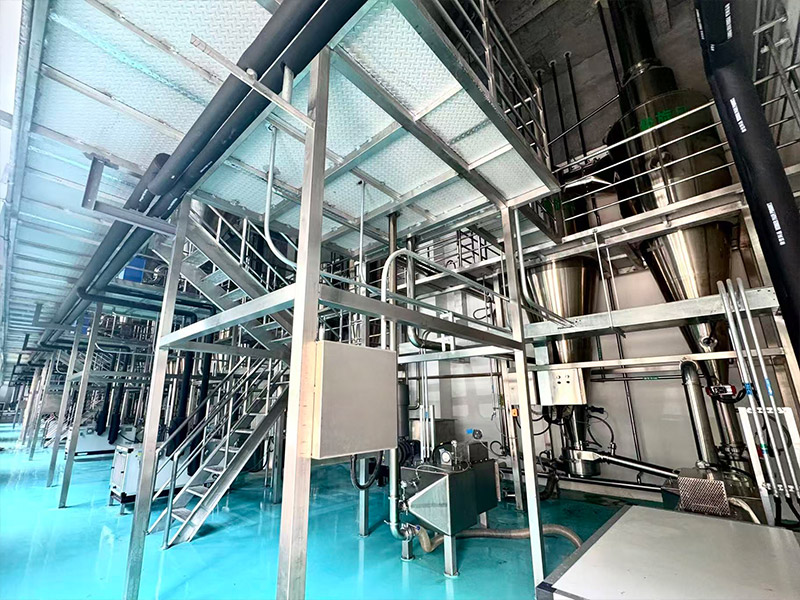
A centrifugal system does not rely on nozzles that can clog or require extremely high pump pressure. Instead, the liquid feed is delivered to a rapidly rotating atomizer disc. The disc throws the liquid outward into thousands of fine, uniform droplets.
Those droplets instantly meet carefully controlled hot air inside the drying chamber. Moisture evaporates in seconds—not minutes. The result is a free-flowing powder with narrow particle-size distribution, good solubility, and minimal heat degradation.
For heat-sensitive products such as milk, probiotics, enzymes, plant extracts, and certain catalysts, few technologies match the speed and gentleness of a high speed centrifugal spray dryer.
2. Key Advantages Over Other Drying Methods
2.1 Faster Drying, Lower Thermal Exposure
Because droplet surface area is massive relative to volume, evaporation happens almost immediately. A high speed centrifugal spray dryer typically completes drying in 5–15 seconds. Short residence time means proteins do not denature, colors stay stable, and active ingredients survive.
2.2 Excellent Powder Uniformity
Centrifugal atomization produces spherical particles with controllable mean size, commonly 40–120 microns. This improves bulk density, flowability, dispersibility, and packaging behavior—critical for automated filling lines.
2.3 Handles Viscous and High-Solids Feeds
Pressure nozzles struggle with sticky or high-solid slurries. A well-designed high speed centrifugal spray dryer handles feeds with wide viscosity ranges and solids contents without frequent blockages.
2.4 Continuous, Industrial-Scale Operation
From lab-scale 5 kg/h evaporation to 10,000 kg/h plant systems, centrifugal spray dryers run 24/7 with PLC/HMI control. This suits detergent bases, ceramic slurries, resin emulsions, and battery-material precursors.
2.5 Cleaner Process Layout
Powder is collected at the chamber bottom plus cyclone/bag-filter stages, giving ≥95% recovery. No intermediate milling or screening is needed for many products, reducing contamination risk and labor cost.
3. Industry-Proven Application Value
| Industry | Typical materials |
|---|---|
| Food & Dairy | whole-milk powder, egg powder, coffee, soy protein, glucose, flavors |
| Chemical | catalysts, white carbon black, dyes, fluorides, additives |
| Ceramics & Minerals | alumina, talc, zirconium compounds, electronic ceramics |
| New Energy | lithium iron phosphate (LiFePO₄), cathode slurries, silica additives |
| Resins | ABS, phenolic, urea-formaldehyde emulsions converted to powders |
4. Why Choose YIBU
4.1 Specialized Manufacturer Since the Early Days
Changzhou YIBU Drying Equipment Co., Ltd. has focused on industrial drying systems for decades. The LPG series high speed centrifugal spray dryer is developed from field data across food, chemical, and ceramic plants—not a resold OEM copy.
4.2 Industry-Standard Drafting Background
YIBU has participated in drafting Chinese industry standards for drying equipment. Tolerances, welding quality, thermal efficiency, and safety logic decide whether your line passes audit.
4.3 Model Range That Matches Real Capacity
YIBU offers LPG-5, LPG-25, LPG-50, LPG-100, LPG-150, and custom LPG-200 to LPG-10000 configurations. Evaporation capacity is matched to feed solids, inlet/outlet temperature, and target moisture—not guessed.
4.4 Material and Hygiene Flexibility
Contact parts can be SUS304, SUS316L, or special alloy. For food and pharma: mirror-polished welds, CIP-compatible design, dead-corner-free chambers. For chemicals: anti-corrosion and explosion-proof versions.
4.5 Atomizer Reliability
The atomizer is the heart of the machine. YIBU configures disc diameter, RPM (8,000–25,000), drive type, and cooling method based on feed behavior. Spare discs, gears, and seals are standardized for fast replacement.
4.6 Dust Collection Engineered, Not “Added Later”
Single cyclone, cyclone + bag filter, or cyclone + wet scrubber. Recovery ≥95% is designed into the system, not claimed after installation.
4.7 Control & Traceability
HMI + PLC with temperature curves, feed-rate interlock, air-volume balance, alarm history, and exportable reports—useful for FDA/ISO/CE documentation and internal QA.
4.8 Global Commissioning Experience
YIBU equipment has been installed in plants across Asia, Europe, North America, South America, and the Middle East. Engineering communication is in English; drawings, manuals, and test reports are delivery-ready.
5. Design Details That Buyers Often Miss
Hot-air distributor angle → controls wall sticking
Tower height/diameter ratio → controls residence time and powder brightness
Atomizer height position → affects droplet dispersion symmetry
Wall-cooling or air-hammer system → reduces build-up for sticky feeds
Secondary-air swirl → improves heat transfer and lowers outlet humidity
Feeding stability → magnetic filter + variable-frequency pump avoids disc imbalance
YIBU reviews these before quoting. That is why the same “LPG-100” from different suppliers behaves differently in the field.
6. When NOT to Use a Centrifugal Spray Dryer
Very coarse granules required → consider fluid-bed or roller drying
Extremely low solid content (10%) with cheap product → energy cost may be high
Solvent-based feeds → need closed-cycle nitrogen system, not standard hot-air type
Small R&D batches with frequent formula change → mini vacuum dryer may be faster to clean
YIBU will tell you this during selection, because a wrong sale costs more than a lost quote.
7. How YIBU Quotes Accurately
Material name + CAS if available
Feed state: solution / emulsion / suspension
Solid content % and viscosity (cp)
Inlet moisture % and target outlet moisture %
Required final capacity (kg/h powder)
Allowed inlet / outlet temperature limit
Target particle size & bulk density
Available utility: electricity, steam pressure, gas, compressed air, water
Material contact requirement: 304 / 316L / other
Emission rule in destination country
8. Total-Cost View for Purchasing Teams
Initial machine price is maybe 40–60% of lifetime cost. The rest is energy, labor, spare parts, downtime, and rejection rate.
A correctly specified high speed centrifugal spray dryer lowers re-drying cycles, milling loss, screen blockage labor, off-spec powder return, and cleaning time between batches.
9. Compliance and Export Readiness
CE declaration support where applicable
Steel material certificates
Welding inspection records
Motor/IP/voltage customization (380V / 415V / 440V / 480V, 50/60Hz)
English operation manual + PID diagrams
Spare-part list with photos
Factory test video before shipment
10. Final Takeaway
If your product starts as a liquid and must become a stable, flowable, low-moisture powder—with tight control over particle structure—centrifugal spray drying is usually the most scalable answer.
The YIBU LPG series high speed centrifugal spray dryer is built on standard-drafting experience, real plant data, and full customization from atomizer to dust collector.
FAQ: Centrifugal Spray Dryer
Q1. What is a high speed centrifugal spray dryer used for?
It converts liquid feeds—solutions, emulsions, suspensions, and pumpable slurries—into dry powder in one continuous step.
Q2. How do I choose the right LPG model (LPG-5 vs LPG-100)?
Model numbers refer to approximate water-evaporation capacity (kg/h), not final powder output. YIBU calculates model size from moisture removed, not just tank volume.
Q3. Can it handle heat-sensitive materials like milk or probiotics?
Yes, when inlet/outlet temperatures and atomizer fineness are set correctly. Residence time is typically 5–15 seconds, much shorter than tray or vacuum tray drying.
Q4. What particle size can be achieved?
Normally 40–120 microns for standard LPG designs, adjustable by disc speed, disc diameter, feed rate, and chamber geometry.
Q5. Why choose YIBU instead of a lower-priced workshop supplier?
Because drying result depends on air distribution, atomizer balance, wall-sticking control, and collector matching—not only plate thickness. YIBU provides industry-standard involvement, model-specific calculations, food/explosion-proof options, English docs, and overseas commissioning support.