



Spin Flash Dryer: The Updated Industrial Solution for Pastes, Filter Cakes, and Sticky Sludges
In modern process industries, the hardest materials to dry are rarely free-flowing powders. They are filter cakes from a press, sticky pigment pastes, agrochemical wet cakes, food protein sludges, mineral concentrates, and high-viscosity residues that smear, lump, or bridge inside conventional equipment. Tray dryers are slow and labor-intensive. Standard pneumatic flash dryers choke on cohesive feed. Spray dryers demand pumpable liquids. Vacuum paddle dryers work, but they are batch, slow, and expensive per ton.
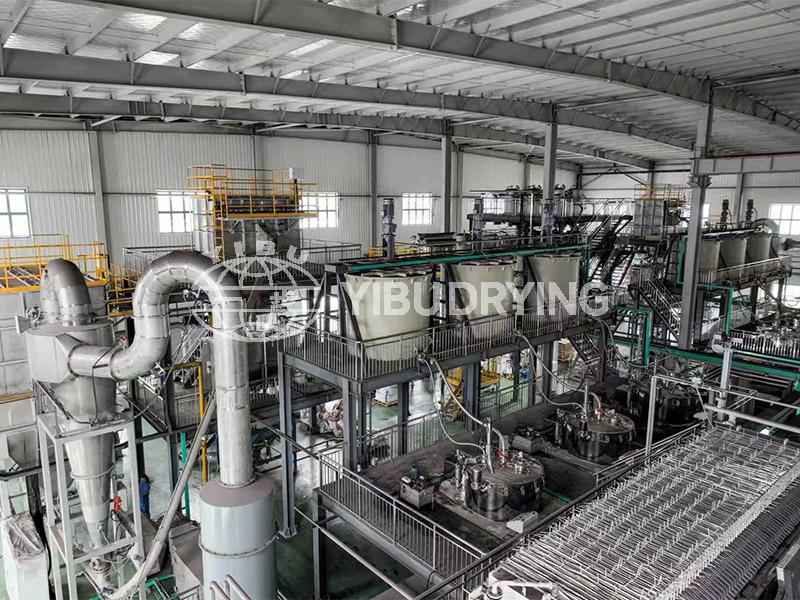
The spin flash dryer fills this gap. It is not simply “a flash dryer with a stirrer.” It is a continuous system where mechanical disintegration, swirling hot-air contact, flash evaporation, and particle classification happen inside one vertical chamber. In 2026, with tighter energy targets, stricter dust and odor rules, and more complex downstream products, the spin flash dryer has moved from a niche chemical-machine option to a mainstream solution for “wet cake → powder in one step.”
1. What a Spin Flash Dryer Actually Does
A spin flash dryer accepts materials that other dryers refuse:
filter press cakes
centrifuge cakes
dye and pigment press cake
agrochemical wet cake
starch, protein, and yeast suspensions
precipitated calcium carbonate, silica, clays
titanium dioxide intermediates
ETP/industrial sludge and sticky process residues
The feed does not need to be pumpable. It only needs to be metered reliably. A screw feeder, piston feeder, or conditioned hopper pushes the wet material into the base of the drying chamber. There, a high-speed rotor, cage mill, or pin-type disintegrator shears the cake into fragments. Tangential hot air creates a vortex. The fragments disperse, expose massive surface area, and dry in seconds.
Because drying is nearly instantaneous, the particle stays close to the wet-bulb temperature while free moisture evaporates. Only after moisture is gone does the particle approach gas temperature—and by then it is already leaving the hot zone. That is why inlet air can be 150–400°C while heat-sensitive products still survive.
2. Updated Working Principle, Step by Step
Feed conditioning: Wet cake from filter press, centrifuge, or nutsche filter is collected and fed at a controlled rate. For very sticky feeds, a pre-lump breaker may be added.
Mechanical dispersion: At the chamber bottom, the rotor breaks lumps into smaller particles. Cage mills are aggressive; pin mills are gentler and dispersion-focused. The right choice depends on cake strength, stickiness, abrasiveness, and target fineness.
Swirling hot-air contact: Hot air enters tangentially, generating a rotating flow field. Gas velocity in the drying zone can be high, often around 20–30 m/s, keeping particles suspended and preventing settlement.
Flash evaporation: Moisture flashes off in 3–30 seconds. Surface moisture disappears almost immediately; bound moisture leaves as particles circulate and classify.
Classification: A top classifier ring or adjustable wheel lets only dry, fine-enough particles escape. Oversized or under-dried particles fall back into the drying zone.
Collection: Dried powder is carried to a cyclone and/or bag filter. Fines recovery is high. Exhaust gas passes through dust collection, and if needed, scrubbing or thermal oxidation.
The key design idea is simple: disintegrate first, dry instantly, classify continuously.
3. Why Plants Are Replacing Older Drying Routes
a) One machine instead of three
Traditional lines often need lump breaking → drying → milling → screening. A spin flash dryer merges dispersion, drying, and size control. Final powder frequently needs no separate milling.
b) Short residence time
Seconds, not hours. Heat-sensitive chemicals, food proteins, and pigments keep their color, activity, and functionality better than in long-residence batch dryers.
c) Compact footprint
No long conveyor belts, no large tray halls, no huge fluid-bed decks for sticky feed. A vertical chamber plus cyclones fits plants where floor space is expensive.
d) Continuous and automatable
Feed rate, rotor speed, air temperature, airflow, and outlet humidity can be tied into a PLC/HMI. Operators set an outlet moisture target; the system modulates inlet temperature and feed rate.
e) Handles “bad behavior” feeds
Cohesive, thixotropic, pasty, or gelatinous materials are exactly what spin flash was built for. A normal flash dryer would plug; a spin flash dryer shears through the problem at the inlet.
4. Spin Flash vs the Alternatives
Feed type | Best technology | Why |
|---|---|---|
Pumpable liquid / solution | Spray dryer | Atomization gives engineered particles |
Free-flowing wet powder, surface moisture | Pneumatic flash dryer | Cheaper, simpler, no disintegration needed |
Sticky paste / filter cake | Spin flash dryer | Rotor breaks cake while hot air dries it |
Granules, crystals, gentle handling | Fluid bed dryer | Long controllable residence, low attrition |
Solvent-wet or oxygen-sensitive cake | Vacuum paddle / conical dryer | Closed system, solvent recovery, inert atmosphere |
The mistake many buyers make is asking, “What evaporation capacity do you have?” before answering, “Will my cake disperse, or does it need to be torn apart mechanically?” Capacity numbers mean little without feed behavior.
5. New Selection Checklist for 2026
A modern RFQ for a spin flash dryer should include:
feed rate and dry-product rate
initial moisture and required final moisture / LOD
cake texture: crumbly, sticky, pasty, thixotropic
bulk density, particle size, abrasiveness
heat sensitivity and max product temperature
pH, salinity, corrosivity
solvent content or combustible-dust risk
required final particle size distribution
heating medium: natural gas, diesel, steam, thermal oil, electric
material of construction: CS, SS304, SS316L, Hastelloy, rubber-lined
exhaust rules: dust, odor, VOC, ammonia, HCL, SOx
explosion protection: venting, suppression, nitrogen inerting
downstream handling: big-bag, silo, mixer, granulator, packer
If the vendor quotes only on “200 kg/h evaporation” and never asks for a sample cake, the project is already at risk.
6. Where It Wins Today
Chemicals and pigments: Dye intermediates, phthalocyanine blue, iron oxide, TiO₂, precipitated silica, calcium carbonate. Color stability and fineness matter more than crystal preservation.
Agrochemicals: Pesticide wet cakes, fungicide press cakes, herbicide intermediates. Continuous powder output replaces manual tray drying and reduces operator exposure.
Food and nutrition: Starch, modified starch, plant protein, yeast, fiber, fruit/vegetable pulp concentrates. Short thermal exposure protects functionality.
Pharma and fine chemicals: Selected APIs and intermediates supplied as wet cake. Not for every molecule—only those tolerant of brief hot-air exposure and mechanical shear.
Environmental: ETP sludge, textile/dye-house sludge, tannery sludge, industrial biosolids. Volume reduction before landfill, incineration, co-processing, or ash recovery.
7. Where It Should NOT Be Used
A spin flash dryer is powerful, but not universal:
Pumpable low-viscosity liquids → use spray or evaporator + spray
Delicate crystals needing zero attrition → use fluid bed
Solvent-based cakes needing recovery → use vacuum/conical dryer
Pellets/granules required as final form → use extrusion/granulation/FBD
Feed varies wildly with no conditioning → stabilize upstream first
Material contains large foreign objects → protect the feeder and disintegrator
Pilot testing matters here. Two cakes at 55% moisture can behave completely differently: one disperses cleanly, the other smears on the wall. A lab moisture report will not predict that.
8. Energy, Emissions, and Plant Reality
The spin flash dryer is efficient because heat transfer happens on dispersed particles with huge surface area. But “efficient” still depends on:
inlet/outlet temperature spread
excess air rate
insulation and duct losses
cyclone/bag-filter pressure drop
heat recovery from exhaust
feed dewatering quality upstream
A filter press at 75% DS will make the dryer far cheaper to run than one fed at 60% DS. In 2026, the smartest drying projects start upstream: dewater harder, dry smaller.
Emissions are also front of mind. Modern systems pair the dryer with:
high-efficiency cyclones
pulse-jet bag filters
wet scrubbers for acidic/odorous vapors
thermal oxidizers for VOC-bearing streams
rotary airlocks and negative-pressure layouts for dust containment
Combustible organic powders need explosion mitigation: pressure relief, isolation valves, spark detection, or inert gas operation depending on dust Pmax, MIE, and plant safety class.
9. Specifying the Machine Correctly
When reviewing a supplier, look beyond diameter and evaporation rate. Ask for:
Guaranteed evaporation on your material, not a generic silica test.
Rotor type, tip speed, motor power, and wear-part material.
Classifier design—fixed ring vs adjustable wheel—and how PSD is controlled.
Feeder design for your cake consistency.
Hot-air source and turndown range.
Chamber geometry: inverted cone base, volute air inlet, wall cooling for heat-sensitive product.
Collection train: cyclone + bag filter + rotary valve.
Control strategy: outlet temperature as the moisture-control variable.
Cleaning access: quick-open doors, CIP where relevant, sanitary finishes for food/pharma.
Documentation: heat/mass balance, P&ID, HAZOP inputs, FAT/SAT, spares list.
The dryer is really a process system, not a steel cylinder with a fan.
10. The Bottom Line
The Spin Flash Dryer remains one of the most pragmatic answers to a very common industrial problem: “We filtered the product, now it’s a sticky cake, and we need powder—without a batch oven, without milling separately, and without plugging the line.”
Its value is not just speed. It is process compression: feed a difficult semi-solid, discharge a controlled, free-flowing powder, recover fines, automate the loop, and shrink the footprint.
For chemicals, pigments, agrochemicals, food proteins, minerals, and industrial sludge, the updated spin flash dryer—with better rotors, smarter classifiers, PLC control, and compliant exhaust trains—is no longer a compromise. It is often the technically correct first choice.
If your plant is still tray-drying filter cake or fighting a flash dryer that was never designed for paste, the right move in 2026 is simple: characterize the cake, run a pilot, and specify a spin flash system around the feed—not around the brochure.