



Centrifugal Spray Dryer Guide: How High-Speed Atomization Turns Liquid Flavors and Additives into Stable Powders
Every food flavor starts its industrial life as a liquid. Orange and peppermint oil emulsions, vanilla-type extracts, meat-flavor preparations, enzyme solutions and sweetener syrups all leave the blending tank wet — yet the market buys them as free-flowing powders that dose accurately, dissolve quickly and stay stable on the shelf. Closing that gap is the job of spray drying, and for many flavor houses and additive plants the workhorse is the centrifugal spray dryer. This guide explains how a high speed centrifugal spray dryer works, why the technology suits heat-sensitive food flavors, how it compares with pressure atomization, and what to check before you invest in one.
A centrifugal spray dryer atomizes liquid feed with a high-speed rotating disc, drying droplets within seconds — a key advantage for heat-sensitive flavors and enzyme products.
Atomizer speed, disc diameter, feed solids and outlet temperature together determine particle size, bulk density, moisture and flowability of the final powder.
For food flavors, spray drying doubles as microencapsulation: wall materials such as maltodextrin, gum arabic or modified starch trap aroma compounds in a protective matrix.
Centrifugal atomization tolerates viscous, high-solids feeds; pressure-nozzle systems, including the two-stage pressure spray dryer, produce larger particles and often better volatile retention.
Industrial units span water evaporation rates from about 5 to 10,000 kg/h, with inlet air of 140–350 °C, outlet air of roughly 80–90 °C and powder recovery of 95% or higher.
What Is a Centrifugal Spray Dryer?
A centrifugal spray dryer converts a pumpable liquid — a solution, emulsion, suspension or slurry — into a dry powder in one continuous step. Its defining feature is the atomizer: a disc or wheel spinning at high speed inside the top of the drying tower. Liquid fed onto the center of the disc is flung outward by centrifugal force and breaks into a fine, umbrella-shaped cloud of droplets that meets a stream of heated air. Because the droplets are tiny, their combined surface area is enormous, so moisture evaporates almost instantly and each droplet becomes a single dry particle.
This one-step route from liquid to powder matters commercially. Products can often be dried without intermediate concentration, milling or sieving, which shortens the process chain and reduces handling losses — a practical benefit when the product is a high-value flavor or a functional additive.
Main components of a centrifugal spray drying system
Feed system: mixing and holding tanks, feed pump, and for flavor emulsions a homogenizer that prepares a stable oil-in-water emulsion before drying.
Centrifugal atomizer: the heart of the centrifugal spray dryer — a motor-driven disc; in industrial high speed centrifugal spray dryer models, rotational speeds typically range from about 8,000 down from 25,000 rpm, with disc diameters from roughly 50 mm on pilot units to 340 mm on large towers.
Air handling: air filter, heater (steam, electricity, gas furnace or fuel oil) and a hot-air distributor that introduces the air in a controlled spiral pattern.
Drying chamber: a stainless-steel tower; food-duty machines commonly specify SUS304 or SUS316L contact parts.
Powder recovery: chamber cone discharge plus a cyclone separator and/or bag filter to capture fines entrained in the exhaust air.
Controls: a PLC + HMI system for inlet/outlet temperature control, monitoring and batch documentation.
How a High Speed Centrifugal Spray Dryer Works
The process is best understood as four linked stages, illustrated below.
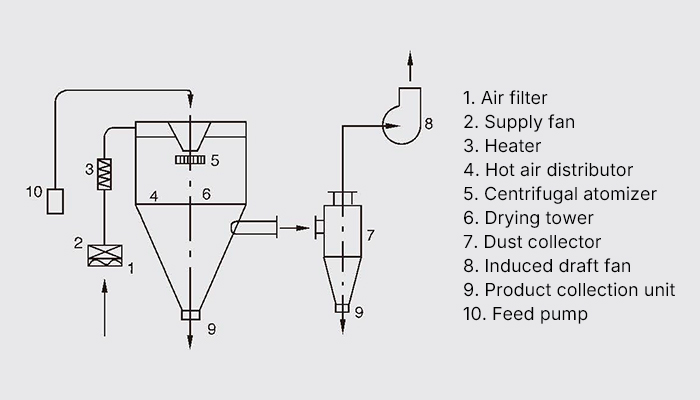
Feed preparation. The liquid is adjusted for solids content and viscosity, homogenized if it is an emulsion, and delivered at a controlled rate to the atomizer.
Atomization. The high-speed disc shears the feed into fine droplets. Droplet size falls as atomizer speed rises, which is why speed and disc diameter are the main levers for particle size control.
Droplet–air contact. Heated air enters the tower top through the distributor and flows co-currently with the spray. Surface moisture evaporates in seconds, and a shell forms around each droplet; the remaining moisture diffuses out and leaves as vapor.
Separation and collection. Most powder leaves through the tower cone; fines are captured by the cyclone and bag filter, and cleaned exhaust air exits through the fan. Overall recovery of 95% or more is a normal expectation for well-tuned industrial systems.
Total contact time between droplet and hot air is measured in seconds. A well-tuned centrifugal spray dryer therefore keeps particle temperature low for most of its flight, even when the inlet air is several hundred degrees — the reason the technology handles heat-sensitive flavors, enzymes and natural colors so well.
Why Food Flavors Are Ideal Candidates for Centrifugal Spray Drying
In the flavor industry, a centrifugal spray dryer does two jobs at once: it removes the water, and it forms microcapsules that lock the aroma into a stable powder.
Spray drying as flavor microencapsulation
Most commercial flavors are oil-based or resinous, so they cannot be dried directly. In flavor encapsulation, the aroma phase — for example orange, lemon or peppermint oil, vanilla-type extracts, or reaction flavors such as yeast extract and chicken extract preparations — is emulsified into a carrier solution of maltodextrin, gum arabic or modified starch. The centrifugal spray dryer then dries this emulsion in a single pass: each droplet becomes a microcapsule in which tiny aroma droplets are locked inside a glassy carbohydrate matrix.
The encapsulated powder brings measurable benefits: aroma compounds are shielded from oxygen and light, volatile losses during storage drop, the powder flows and doses cleanly into beverage and bakery premixes, and release can be triggered by heat or moisture during end use.
What actually protects the aroma
High feed solids. Concentrated feeds (commonly in the 20–60% range, depending on the material) shorten the drying trajectory and reduce the time volatiles can diffuse out.
Controlled outlet temperature. Keeping outlet air around 80–90 °C, or lower for very volatile systems, limits aroma flash-off and thermal degradation.
Rapid shell formation. Fast evaporation builds a solid matrix quickly, trapping flavor inside rather than letting it migrate to the particle surface.
Gentle handling after drying. Powder should be cooled promptly and packaged with low oxygen exposure; integrated conveying and cooling sections support this.
Compliance sits with the formulation, not the dryer, but hygiene matters. Flavorings and additives must meet the regulations of each destination market — for instance, the EU safety evaluation of flavourings or the U.S. regulatory status lists for direct food additives (see references below). Food-contact surfaces of SUS316L, polished welds and cleanable ducting make it easier for processors to meet those hygiene expectations consistently.
Key Process Parameters at a Glance
The table below summarizes typical industrial operating ranges for centrifugal spray dryers, based on published specifications for the LPG series of high speed centrifugal spray dryer models.
| Parameter | Typical industrial range | Why it matters |
|---|---|---|
| Water evaporation capacity | 5 – 10,000 kg/h | Scales from pilot testing to full production lines |
| Atomizer speed | 8,000 – 25,000 rpm | Primary control of droplet and powder particle size |
| Atomizer disc diameter | 50 – 340 mm | Sets spray coverage and throughput per tower size |
| Inlet air temperature | 140 – 350 °C, automatic control | Drives evaporation rate; limited by product heat sensitivity |
| Outlet air temperature | approx. 80 – 90 °C | Governs final moisture and volatile retention |
| Feed solids (flavor emulsions) | commonly 20 – 60% | Higher solids improve economics and aroma retention |
| Powder recovery | ≥ 95% | Directly affects yield and filter load |
| Final product moisture | typically ≤ 5% | Ensures flowability and shelf stability |
These are reference windows, not guarantees. The exact operating point for a given flavor or additive is set by pilot testing, because solids level, viscosity and volatility vary widely between products.
Centrifugal vs. Pressure Atomization — and Where the Two-Stage Pressure Spray Dryer Fits
Centrifugal atomization is not the only route. In a pressure spray dryer, a high-pressure pump (typically 2–10 MPa in industrial series) forces the feed through a nozzle at the tower top, producing a co-current spray of larger droplets. A two-stage pressure spray dryer extends this concept: the first stage is the spray tower itself, and the second is an integrated fluid bed that gently finishes drying and cools the powder before discharge.
| Aspect | Centrifugal (disc) atomization | Pressure nozzle, incl. two-stage |
|---|---|---|
| Typical particle size | Finer particles, commonly tens of micrometers | Larger particles, commonly around 100–300 μm |
| Feed tolerance | Handles viscous, high-solids and slurried feeds | Needs low-viscosity, well-filtered feed to avoid nozzle blockage |
| Volatile retention | Good with tuned outlet temperature | Larger droplets often retain aroma better |
| Product texture | Fine, free-flowing powder | Denser powder; two-stage designs can agglomerate for instant products |
| Final moisture control | Set in the tower | Two-stage fluid bed gives gentler finishing and cooling |
| Typical duties | Flavor emulsions, colorants, enzymes, compound additives | Meat flavors, coffee and tea extracts, sweeteners, instant agglomerates |
In practice, flavor producers often run both technologies: a centrifugal spray dryer for emulsified, high-solids or viscous feeds, and a two-stage pressure spray dryer where coarser particles, higher bulk density or instant solubility are the product targets. Many facilities also recover fines from the second stage and return them to the feed tank to improve yield.
Food Flavor and Additive Materials Commonly Spray Dried
Industrial spray drying lines for this sector handle a wide spectrum of liquids. Typical examples include:
Flavors and essences: natural oils and extracts of the orange, lemon, mint, cinnamon and vanilla families; fruit-type essences such as banana and strawberry; Maillard-type reaction flavors built on yeast extract or meat extract bases; and synthetic notes such as vanillin or ethyl maltol.
Sweeteners: sucralose, acesulfame-K, stevia glycosides and erythritol-based blends, often dried as compounded or carrier-blended powders.
Colorants: curcumin, monascus red and other natural pigment preparations, usually emulsified with carriers before drying.
Preservatives and antioxidants: potassium sorbate and related salts, tea polyphenols and emulsified vitamin E preparations.
Thickeners and hydrocolloids: xanthan gum, sodium alginate, pectin and carboxymethyl cellulose solutions.
Enzymes: amylase, glucoamylase and protease preparations, dried under reduced-temperature profiles to preserve activity.
Acidulants and functional blends: citrate and lactate solutions, phosphate blends, compound leavening agents and anti-caking preparations.
Whether a specific material suits centrifugal atomization depends on its solids level, viscosity, volatility and heat sensitivity — and should always be confirmed with a pilot test before a centrifugal spray dryer is sized and quoted.
Testing your flavor before you buy? Send your feed sample for pilot spray drying — particle size, moisture and aroma retention are evaluated on real equipment before scale-up.
Get a QuoteHow to Evaluate a Centrifugal Spray Dryer for Your Flavor Plant
Pilot evidence first. Ask the manufacturer to run your feed on pilot equipment and report particle size distribution, moisture, bulk density and recovery — before the centrifugal spray dryer is sized, not after.
Food-contact construction. SUS316L contact parts, smooth internal welds and accessible ducting support hygiene and cleaning routines.
Cleaning and changeover. Flavor plants run many products; CIP options, quick-release atomizers and easy-inspection chambers shorten changeovers.
Recovery matched to the product. Cyclone, bag filter or combined arrangements should be selected against the target particle size and allowable powder loss.
Energy flexibility. Steam, electric, gas and oil heating options let the system match the energy available on site; two-stage designs recover heat and reduce thermal load on heat-sensitive products.
Controls and documentation. PLC + HMI control with recipe management and temperature logging simplifies audits and reproducibility between batches.
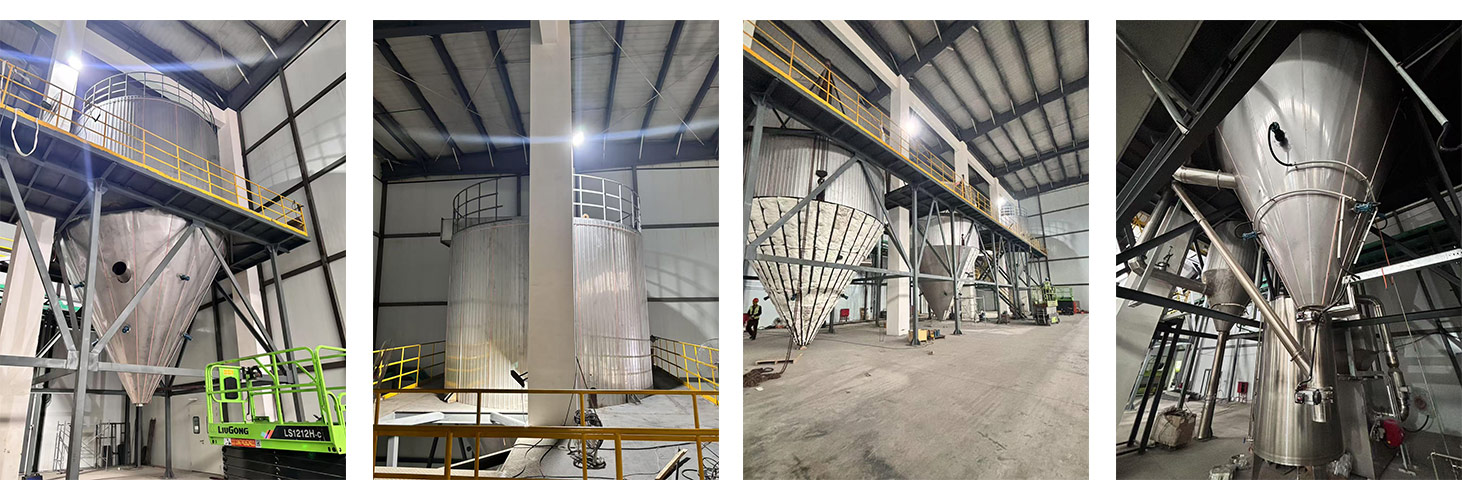
LPG Series High Speed Centrifugal Spray Dryer
Centrifugal atomization for solutions, emulsions and pumpable flavor feeds. Water evaporation from 5 to 10,000 kg/h, inlet air 140–350 °C with automatic control, outlet approx. 80–90 °C, powder recovery ≥ 95%, SUS304/316L contact parts and PLC + HMI control.
View Product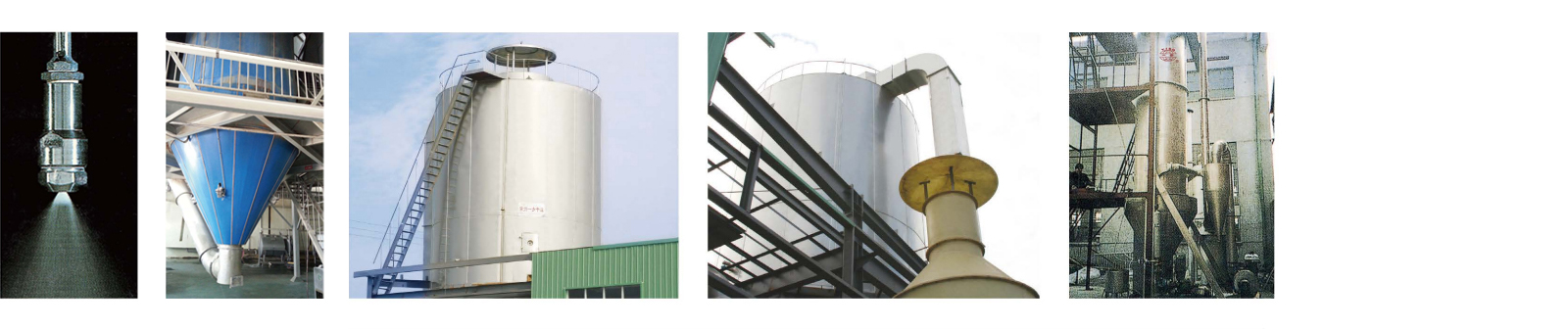
YPG Series Pressure Spray Dryer (Co-Current)
Pressure-nozzle atomization with a 2–10 MPa high-pressure pump and co-current drying at 200–300 °C inlet air. Final moisture below 5% and recovery above 97%; configurable with second-stage fluid-bed drying and cooling for two-stage operation on heat-sensitive flavor powders.
View ProductNeed a centrifugal spray dryer for food flavors or a two-stage pressure spray drying line? Share your feed data and target capacity, and our engineers will recommend the configuration and quote for your project.
Contact UsConclusion
The centrifugal spray dryer earns its place in food flavor and additive production by combining speed with gentleness: droplets dry in seconds, yet particle temperatures stay low enough to preserve aromas, enzyme activity and natural colors. Its tolerance of viscous, high-solids feeds makes it the default choice for emulsified flavor systems, while two-stage pressure spray dryers cover duties that need larger particles, higher bulk density or instant agglomerates. The deciding factor is rarely the catalogue — it is what a pilot test proves on your own material. If you are looking for a reliable high speed centrifugal spray dryer manufacturer for food flavors and additives, YIBU Drying Equipment offers LPG centrifugal and YPG pressure series, a 2,000 m² pilot laboratory and complete turnkey powder processing lines — contact us for a tailored recommendation.
FAQ
1. What capacity range does an industrial centrifugal spray dryer cover?
Commercial series span water evaporation from about 5 kg/h on pilot units to roughly 10,000 kg/h on large single towers. The right size follows from your product output target, feed solids and the operating temperatures confirmed in testing.
2. Which is better for flavors: a centrifugal spray dryer or a two-stage pressure spray dryer?
Neither is universally better. A centrifugal spray dryer is the more flexible choice for viscous, high-solids emulsions, while pressure and two-stage systems usually deliver larger particles, higher bulk density and often better volatile retention. A pilot comparison on your flavor is the fastest way to decide.
3. What particle size can the powder achieve?
Centrifugal systems typically produce fine powders in the tens of micrometers; higher atomizer speed gives finer particles. Pressure-nozzle systems reach larger particles around 100–300 μm, and agglomeration in a second-stage fluid bed can build instant, free-flowing granules.
4. Can spray drying preserve heat-sensitive ingredients such as enzymes?
Yes, within tested limits. Short residence time, automatic inlet/outlet temperature control and low outlet temperatures (commonly 80–90 °C or lower) limit thermal exposure. Actual activity retention must be verified by pilot runs for each enzyme or probiotic product.
5. How is the aroma retained during drying?
Aroma retention in a centrifugal spray dryer depends on formulation and process together: carrier systems such as maltodextrin or gum arabic form a protective matrix, high feed solids shorten drying, and controlled outlet temperatures prevent volatiles from flashing off. Post-drying cooling and tight packaging complete the protection.
6. What information should I give a manufacturer for an accurate quotation?
Feed composition and solids, viscosity, initial temperature, target moisture and particle size, required capacity, available heat source and hygiene requirements (SUS304 vs. 316L, CIP). With these data, a supplier can propose a centrifugal spray dryer model, an operating window and a recovery arrangement — and verify them on pilot equipment.